
How to Read a Blazon
How to read heraldry blazon text: the fixed word order, the color and metal names, placement terms, and three real blazons translated line by line.
By the Coat of Arms Creator team
A blazon is the written description of a coat of arms, and learning how to read heraldry really means learning the order a herald writes in. That order never changes. The field comes first, then the main shape laid across it, then the charges, then whatever sits on top. Learn the sequence and about twenty heraldry terms and you can turn the blazon text in a family record or an old roll back into a shield.
What a blazon does that a picture cannot
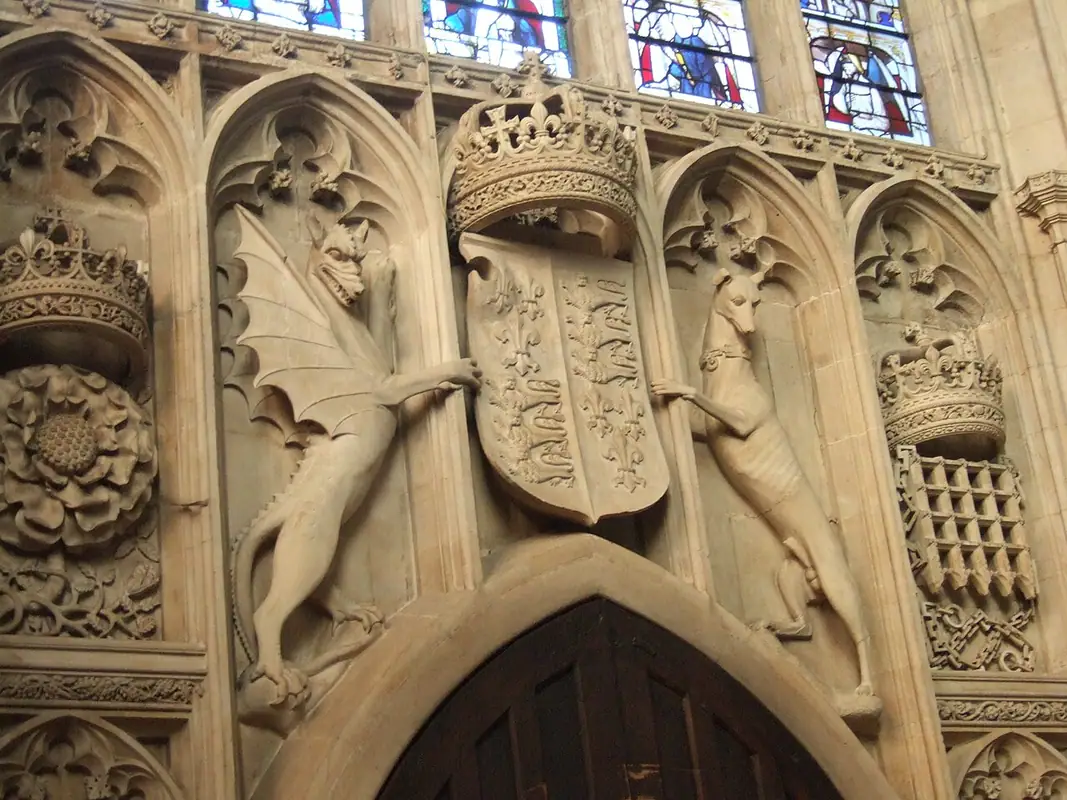
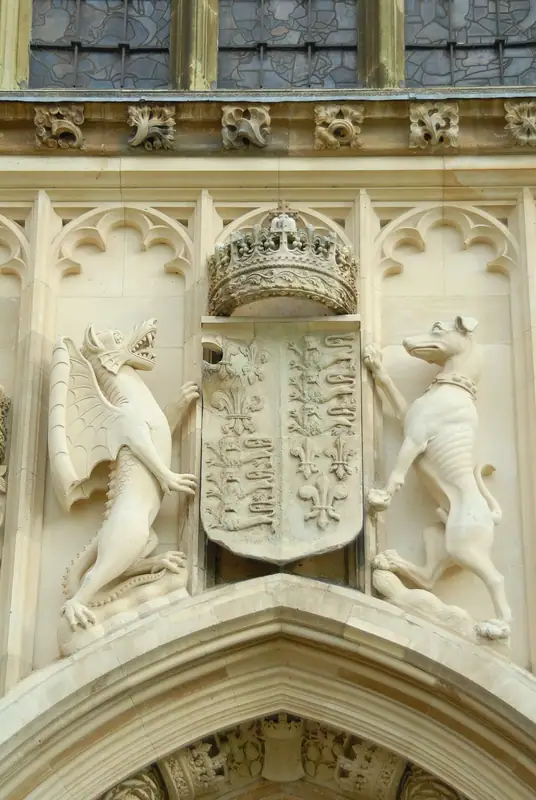
Give the same blazon to two artists and you get two different shields. The lions will have different faces, the shield will be a different shape, the red may be darker or brighter. Both drawings are correct. A blazon pins down what heraldry treats as the arms, which is the colors, the shapes, the number of charges and their placement, and leaves style to the artist.
That is why the words are so compressed. A blazon reads more like a spec than a sentence. It drops verbs, puts adjectives after nouns, and uses commas to separate stages of the description rather than to mark pauses.
The fixed word order
Nearly every shield blazon follows these five steps.
1. The field
The field is the background, and its tincture is named first with no article and no verb. “Azure” on its own means a plain blue shield. If the field is divided, the division is named here instead: “Per pale Gules and Argent” means split down the middle, red on the holder’s right, white on the holder’s left.
2. The main ordinary
Next comes the big geometric band, if the arms have one. An ordinary is a shape such as a fess, which is a horizontal band, or a pale (vertical), a bend (diagonal), a chevron or a saltire. It gets its own tincture: “Azure, a fess Or.”
3. Charges on the field
Then the charges: animals, plants, objects, stars, crosses. The number comes first, then the charge, then its posture, then its tincture. “Three lions passant guardant Or” means three gold lions walking, each head turned to face you.
4. Charges on the ordinary
Anything resting on the band is blazoned after the band and introduced by “on”: “a fess Gules, on the fess three mullets Argent.” Charges that flank the band use “between” instead.
5. The chief and the last marks
A band across the top of the shield, called a chief, is usually blazoned last because it is laid over the rest of the design. Small marks that tell younger sons apart come at the very end.
Naming colors and metals
Tinctures split into two metals, five colors and a set of furs.
| Word | What it means | Type |
|---|---|---|
| Or | Gold or yellow | Metal |
| Argent | Silver or white | Metal |
| Gules | Red | Color |
| Azure | Blue | Color |
| Sable | Black | Color |
| Vert | Green | Color |
| Purpure | Purple | Color |
| Ermine | White with black tails | Fur |
| Vair | Blue and white bell shapes | Fur |
Two more words come up constantly. “Proper” means drawn in its natural colors, so a boar proper is a dark bristly boar rather than a heraldic tincture. “Counterchanged” means the colors of a divided field swap over as a charge crosses the dividing line.
The tincture names also act as a check on your reading. Heralds avoided putting color on color or metal on metal, so if your reading has a red lion on a blue field, you have probably misread which word belongs to which part.
Counting and placing charges on the shield
When a blazon gives a number and nothing else, use the default arrangement. Three charges sit two above and one below. Two sit side by side. Anything other than the default is spelled out, usually with one of these phrases.
| Phrase | Where it puts things |
|---|---|
| in chief | near the top of the shield |
| in base | near the bottom |
| in fess | in a horizontal row |
| in pale | stacked in a vertical column |
| in bend | in a diagonal line |
| in saltire | arranged in an X |
| between | flanking the ordinary |
| on | sitting on the ordinary |
| dexter | the holder’s right, your left |
| sinister | the holder’s left, your right |
Dexter and sinister trip up most first readers. Heraldry describes the shield from behind it, as the person carrying it would see it, so dexter appears on your left.
Reading the crest and motto lines
Longer records describe the whole display, not just the shield. The shield blazon ends, then a new line begins with the crest, often written as “on a wreath of the colours” followed by the figure itself. The wreath colors are the main metal and main color of the shield, which is why they are not spelled out.
The motto usually comes last, in quotation marks or italics, with no translation. Supporters, if the arms have any, are blazoned between the crest and the motto.
Three blazons read line by line
“Azure, three fleurs-de-lis Or.” Blue field, three gold fleurs-de-lis, two above and one below. No ordinary, no extras.
“Gules, three lions passant guardant in pale Or.” Red field. Three gold lions, walking, heads turned out at you, stacked in a column because of “in pale.” This is the historic coat of England.
“Argent, a chevron Gules between three mullets Sable.” A made-up example in a very common pattern. White field, red chevron across it, three black stars around the chevron, two above and one below. Red on white keeps the color on metal rule.
Turning a blazon back into a drawing
Work in the same order you read in.
- Paint the field, including any division.
- Lay the ordinary over it.
- Add the field charges in their default spots unless a phrase moves them.
- Add the charges that sit on the ordinary.
- Add the chief and any mark of difference.
- Build upward from the shield: helm, wreath, crest, then the motto scroll.
If a step leaves you guessing, the blazon is probably incomplete or copied with a word missing. Old family papers do this often.
Draw one in the Coat of Arms Maker
Reading sticks faster once you build a shield. The free Coat of Arms Maker lets you set a field, drop in an ordinary, place charges and add a crest and motto, so you can test a blazon you found and see whether your reading of it holds up.
Frequently asked questions
How do you read a blazon?
Read it in the order it was written. The field comes first, then the main band or ordinary, then the charges with their number, posture and tincture, then anything sitting on the band, then the chief. Crest and motto come as separate lines after the shield. Adjectives follow their noun, so a lion rampant Or is a gold rearing lion.
What does "Azure, three fleurs-de-lis Or" mean?
It means a blue shield with three gold fleurs-de-lis on it. Azure is blue, Or is gold or yellow, and three charges default to the two-and-one arrangement: two side by side near the top, one below them. That blazon is the later coat of the kings of France, often called France Moderne.
Are heraldry terms Latin?
Mostly not. English blazon vocabulary comes largely from Norman French, which is where gules, azure, argent, bend and rampant come from. Latin turns up in mottos rather than in the description of the shield itself. You do not need either language to read a blazon, only the short list of words heralds reuse.
Why do two drawings of the same blazon look different?
Because a blazon fixes only what heraldry counts as part of the arms: the tinctures, the shapes, the number of charges and where they sit. Shield outline, drawing style, the exact shade of red and the face of an animal are left to the artist. Two very different pictures can both be correct.