
Personal Coat of Arms Examples and What They Mean
Four personal coat of arms examples with meanings explained: a simple one charge shield, trade arms, place arms and arms for a blended family.
By the Coat of Arms Creator team
Here are four personal coat of arms examples with their meanings broken down piece by piece. Each one is a complete design: field, charges, crest and motto, with a reason behind every choice. None of them is an inherited grant. They are arms a person or family could assume for themselves, which is where most people start. For the full method behind them, see the guide on how to make a coat of arms.
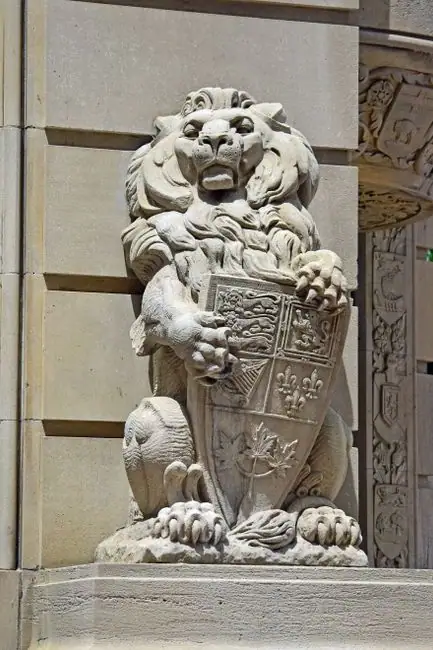
One thing to settle first. People searching for family crest examples are often hoping to find the arms tied to their surname. Surnames do not carry arms. Arms belong to a person and that person’s descendants, not to everyone who shares a last name. So treat what follows as examples of design you can borrow the structure from, rather than records to look yourself up in.
How to read these examples
Each example gives a blazon, the parts it is built from, and the thinking behind it.
The blazon is the formal description. It names the field (the background) first, then whatever sits on it. “Azure, a fleur-de-lis or” means a blue shield with one gold fleur-de-lis. If that word order feels backwards, reading a blazon explains the grammar.
Two habits run through all four designs. They stick to two or three tinctures. And they keep metal and colour apart. Gold and silver (drawn as white) are the metals. Red, blue, green, black and purple are the colours. Heraldry avoids metal on metal and colour on colour so the shield stays readable from a distance.
Example 1: a simple one charge design
Blazon: Azure, a fleur-de-lis or. Crest: a fleur-de-lis or. Motto: Quiet and sure.
This is the plainest kind of arms there is. Blue field, one gold flower, nothing else. The charge is drawn large, filling most of the shield. That is what makes a simple design look old rather than empty. Medieval arms had to be recognised across a field, so one big shape beat five small ones.
Why it holds up: the fleur-de-lis stands for French ancestry on the mother’s side, and gold on blue gives the sharpest contrast in heraldry. The crest repeats the shield charge, which is common practice and saves you inventing a second idea.
What to change: swap the fleur-de-lis for any single object that stands for you. Keep the one colour, one metal setup.
Example 2: arms built around a trade
Blazon: Or, a chevron gules between three oak trees eradicated vert. Crest: a hand holding a mallet. Motto: By hand and eye.
These belong to a family of builders. The chevron reads as a roof or a pair of rafters, which is why trades that put things together often reach for it. The three oak trees stand for the timber the work depends on. Eradicated means the trees are shown with their roots torn up, which is the standard heraldic way to draw a whole tree.
Why it holds up: the trade appears twice, once in the shape of the band and once in the charges, so the message survives even when the shield is printed small on a letterhead or stamped into a ring. The count stays at one metal and two colours.
What to change: pick a different band and different charges. A baker might use wheat, a sailor an anchor, a teacher an open book.
Example 3: arms built around a place
Blazon: Per fess vert and argent, in chief a sun in splendour or, in base a bar wavy azure. Crest: a demi-heron argent. Motto: From the valley.
The field is split across the middle, green above for the hills and white below. A gold sun sits in the upper half. A wavy blue bar crosses the lower half for the river. Wavy lines mean water in heraldry, one of the few conventions that reads the same way almost everywhere.
Why it holds up: the division does half the storytelling, so the shield needs only two charges to say where the family is from.
What to watch: place arms can drift into picture painting. Heraldry uses flat shapes with hard outlines, not scenery with perspective and shading. One hill shape beats a painted view of the valley.
Example 4: arms for a blended or adopted family
Blazon: Per pale azure and vert, a tree argent, in chief three mullets or. Crest: a dove argent. Motto: Two roots, one tree.
The shield is split down the middle, blue for one side of the family and green for the other. A single white tree grows across the join, so neither half is whole without the other. The three gold mullets (stars) along the top stand for the three children, however each of them arrived.
Old heraldry handled marriage by impaling two existing coats side by side on one shield. If you have no inherited arms to impale, a shared charge crossing the divide does the same job and looks better than two halves that ignore each other.
What each example got right
- One idea per shield, stated once and stated clearly.
- Two or three tinctures, never a rainbow.
- Metal against colour at every contact point, so nothing disappears.
- Charges drawn big, filling the space they are given.
- A motto of two to five words, in plain language.
- Meaning tied to something true: a trade, a place, a family, not a symbol chosen at random.
Adapt one of these for yourself
Take the example closest to your situation and change the content, not the structure.
- Keep the field division and swap the colours.
- Replace the charges with symbols that mean something to you. Coat of arms symbols and their meanings covers the common ones, and what to put on yours works through family, trade, place and belief if you are short on ideas.
- Hold the count at one to three charges.
- Add a crest that repeats or answers the main charge.
- Write a short motto in any language you like.
In most countries none of this needs permission. You can make your own coat of arms and use it on invitations, a signet ring or a reunion banner. It is not an official grant. Scotland is the exception, where arms have to be recorded with the Court of the Lord Lyon.
Build yours in the coat of arms maker
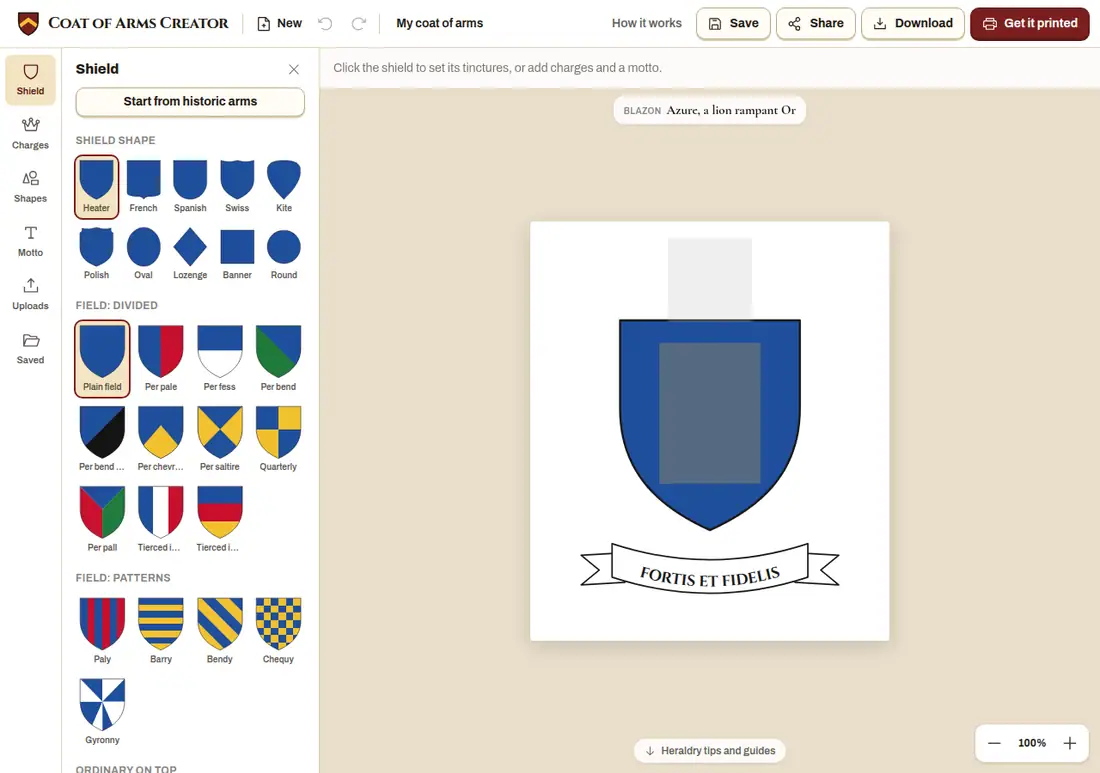
Every piece used above exists in the coat of arms maker on the home page: the shield shapes, the field divisions, the tinctures by their heraldic names, the charges and the motto scroll. You can rebuild any of these four examples in a few minutes, then start changing charges until the design is yours. It is free to use, and you can download the finished shield when you are happy with it.
Frequently asked questions
What is a good example of a personal coat of arms?
A strong example is one charge on one field, such as a blue shield with a single gold fleur-de-lis. The charge is drawn large, there are only two tinctures, and the meaning is personal to the bearer. Plain designs like this read clearly on a ring, a seal or a printed invitation, and they look closer to real heraldry than crowded ones.
Are there real family crest examples for my surname?
Not in the way most people hope. Arms were granted to a person and passed to that person's descendants, so a surname by itself carries no coat of arms. Two families with the same last name can have completely different arms, or none at all. Sites that sell a crest for any surname are matching a name, not your family line.
What makes a simple coat of arms example work?
Three things. One main charge, or three copies of the same charge, drawn big enough to fill the shield. Two or three tinctures, no more. And contrast, meaning a metal on a colour or a colour on a metal, never metal on metal. A design that passes those three tests stays readable when it is shrunk to the size of a coin.
Can I copy one of these examples for my own family?
Copy the structure, not the whole design. Keep the field division, the number of charges and the colour pairing, then swap in symbols that mean something to your family. Copying an existing set of arms exactly is poor practice and, in some countries, a legal problem. Changing the charges and tinctures gives you something that is yours.